
Shades News
Reimagining how younger generations stay informed
through an AI-powered, gamified news experience.
Role
Timeline
Skills/Tools
UX Research Intern
Jan 2025 - March 2025
UX Research
User Interviews
User Personas
Affinity Mapping
Competitive Analysis
Mobile UI Design
Figma
PROJECT SUMMARY
Shades News is a news and culture app designed to help young digital-native users explore current events through quick, multi-perspective summaries. The app leverages AI to curate diverse viewpoints from verified sources in an engaging, gamified, and interactive format, promoting balanced and transparent information consumption.
As a UX researcher in the Winter 2025 cohort, I investigated how users consume and interact with the app and its content, synthesizing multimodal data to inform improvements to UI design, news summary generation, and navigational flow,
as well as to strengthen user trust in the platform's transparency and impartial reporting process; ultimately driving early user retention and session length.
CONTEXT
Since the late 2010s, as short-form, algorithm-driven platforms like TikTok and Instagram have become central to online culture, younger audiences are increasingly turning to social media and online communities as their primary sources for news.
Studies show that 42.9% of Gen Z get news from social media daily, with others
reporting that roughly 63% turn to social media at least once a week for news. While this shift offers immediacy and accessibility, it has also led to fragmented information ecosystems, where users encounter varying levels of credibility and an overload of opinions that make it difficult to form a balanced understanding of events.
Shades was created to transform information consumption by presenting concise, multi-perspective summaries aggregated from diverse sources ranging from
traditional journalistic outlets to community-driven discussions, all while adding a touch of fun through interactive, gamified features that reward active engagement.
THE CHALLENGE
“How might we design an engaging, gamified experience that helps Gen Z users explore diverse perspectives and make sense of complex information in a fragmented media landscape?”
RESEARCH GOALS
& METHODOLOGY
Through my research, I aimed to uncover both behavioral patterns and emotional drivers behind how Shades' target demographic (17–25-year-olds) engage with the app. My primary goals were to…
Deeply understand the complex, qualitative nuances
of the habits, motivations,
and frustrations of current
and prospective users.
Examine Shades’ positioning relative to market competitors to identify opportunities to strategically differentiate.
Evaluate whether gamification supports or undermines perceived credibility in news engagement experiences.
Prioritize UI + UX improvements to make the app’s look and navigation more approachable, intuitive, and shareable.
To address these goals, I used a mixed-methods approach:
Qualitative research in the form of 26 one-on-one user interviews, each consisting of a detailed walkthrough of the app and open-ended questions to explore how users discovered, engaged with, and evaluated content across the platform. Participants aged 17–25 were recruited through independent outreach efforts across my university, as well as neighboring states (NJ, NY), to capture a range of perspectives representing Shades’ target audience.
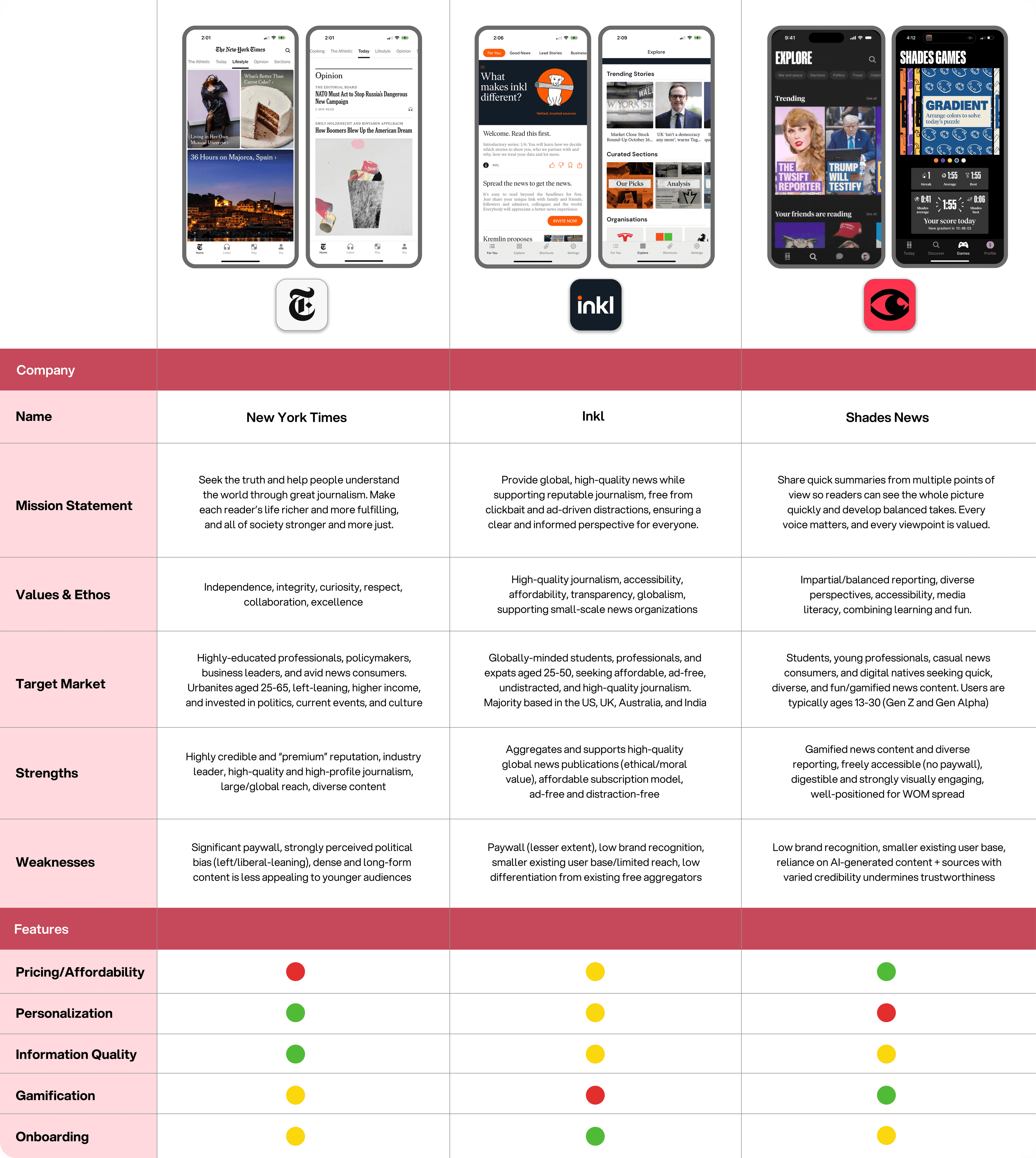
A competitive analysis evaluating Shades' positioning relative to existing news platforms to contextualize its value proposition within the broader news media and information landscape.
USER INTERVIEWS
In each user interview, I followed a semi-structured protocol moving from context to active reflection, blending reflective discussion with open app exploration.

Background & Habits. Participants shared their demographics, personal background, motivations, and news consumption habits (establishing context).
"Tell me more about your desire to stay informed, and what it means to you."
”What platforms do you typically use to stay informed?”

Visual Design & Brand Identity. In a live walkthrough of the app, participants shared first impressions, UI preferences, and their overall perception of Shades.
“What's your initial perception of Shades’ 'brand' or purpose?”
“Walk me through your experience scrolling around. What catches your eye?”

Information, Organization, & Navigation. Participants then evaluated the app’s layout, ease of navigation, usability, perceived credibility of content.
“Is Shades’ layout intuitive? Do you like or dislike how it’s organized? Why?”
“How informed did you feel after reading your latest Shades story?”

Closing Reflections. Participants summarized their experience, highlighting what resonated, fell short, and would encourage them to become power users.
“What would make you use Shades more often?”
“How would you describe this app to a friend who’s never heard of it?”
COMPETITIVE ANALYSIS
To contextualize Shades within the broader media and information landscape, I performed a competitive analysis comparing it to The New York Times and Inkl. This clarified Shades' positioning, highlighted its strength in a gamified, aggregative approach, and uncovered opportunities to improve across the dimensions of content personalization, credibility, and onboarding.
KEY FINDINGS
Through affinity mapping/thematic analysis, I distilled findings into three key insights…
Users highly value personalization and transparency in how information is curated.
Across 77% of interviews, participants wanted relevant, trustworthy, and concise news, with control over topics and clear visibility into where information comes from.
“I want the app to learn what I care about, not just show me random trending stories.”
Visual design directly influences how users interpret Shades' credibility and intent.
65% of users described Shades' UI as engaging but inconsistent, noting that bright colors and varied styles sometimes undermined the app’s seriousness.
73% of users also felt that the app's AI-generated visuals raised doubts about the level of human oversight in content curation, further undermining trust.
“It does look cool and Gen Z, but it also feels a little too fun for something that’s supposed to be news.”
Gamification invites engagement, but can also create confusion around blurred boundaries between news and play.
About 46% of users liked social and interactive game elements, but many were unclear on their meaningfulness, function, or relevance to news.
“I like that it’s fun, but I’m not sure what the games actually add. Are they part of the news, or just there for engagement?”
… and four central pain point groupings grounded in participant feedback.
Visual Overload &
Brand Dissonance
Overly bright, mismatched visuals cause eye strain and make the platform feel less credible.
Limited Social Interactions
Minimal likes, comments, "takes", and polls result in low engagement and an isolated user experience.
Distrust in AI-Generated Content
Irrelevant or clashing AI visuals cause users to question the quality of the app’s content curation.
Confusing Navigation &
Information Hierarchy
Unintuitive layout and a rapid onboarding tutorial make it hard for users to grasp core features.
USER PERSONAS
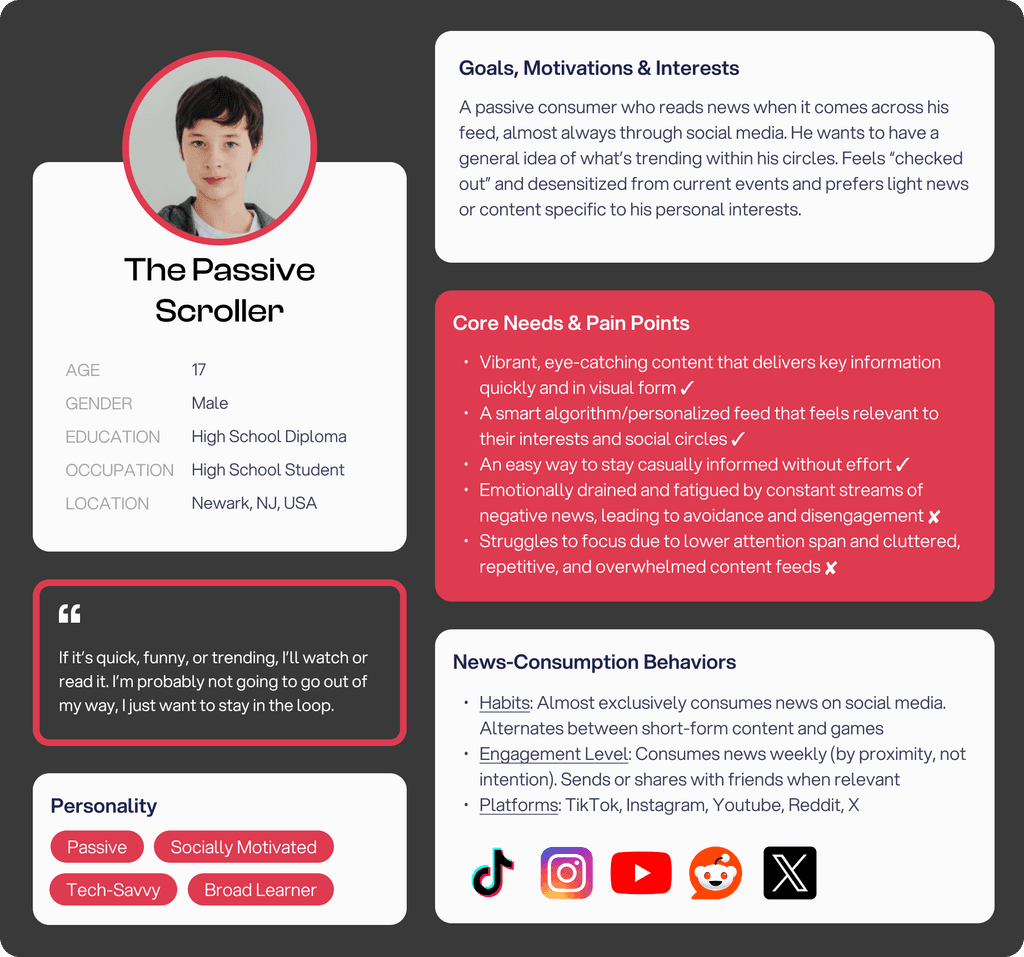
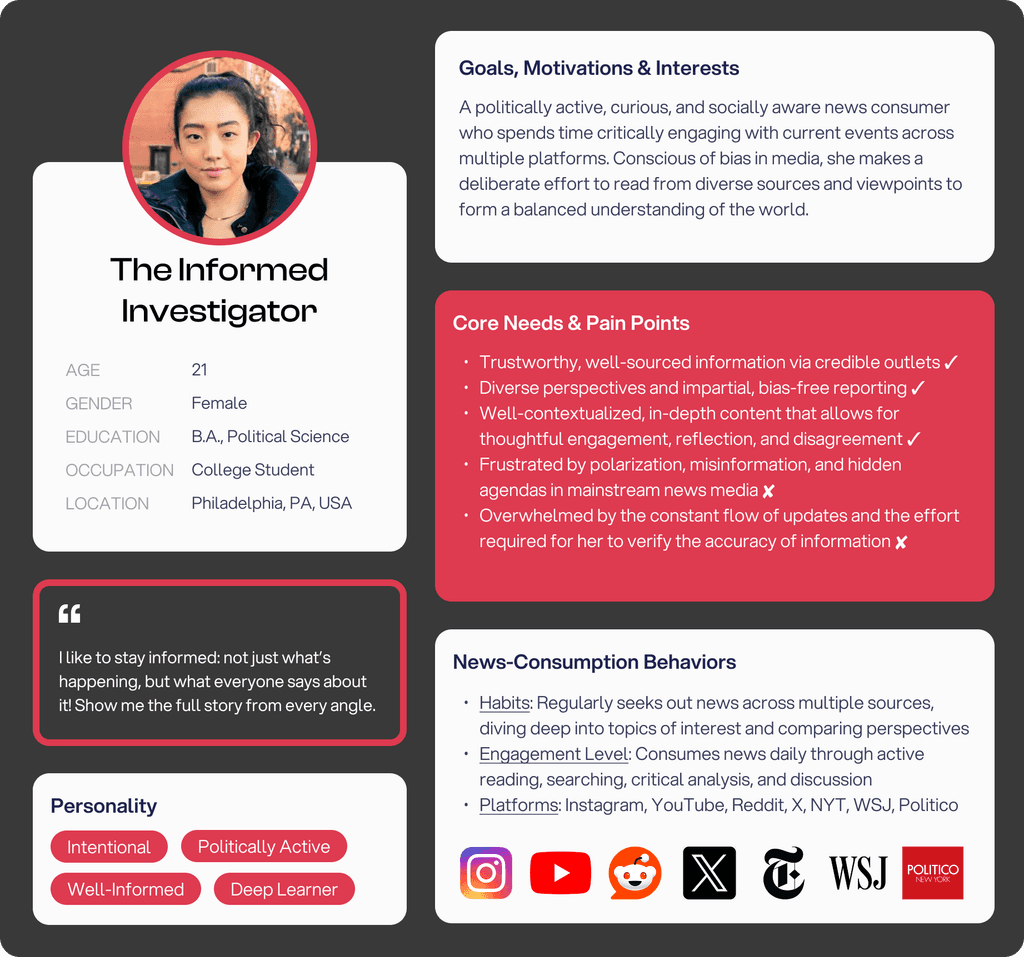
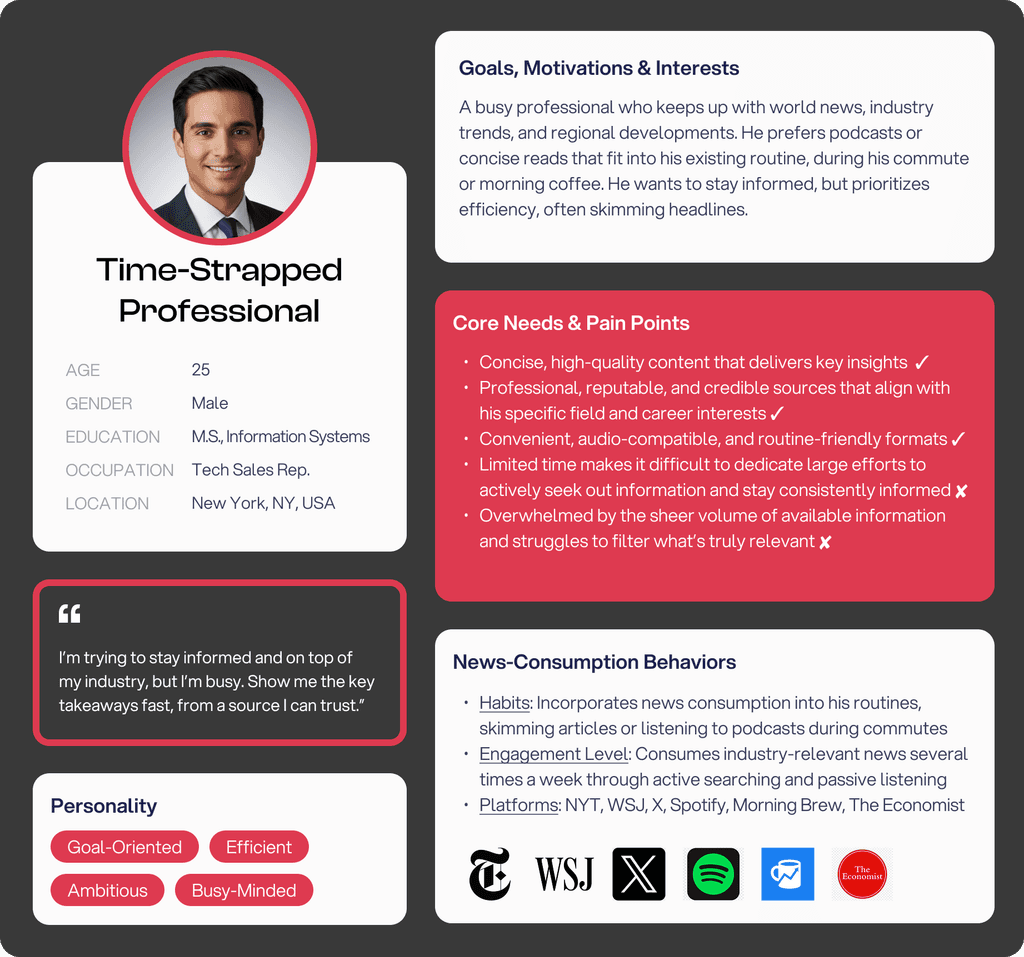
I developed three distinct user personas capturing core audience segments and their unique needs, motivations, and behaviors.

JOURNEY MAPPING
User journey maps to visualize moments of engagement, friction, and opportunity throughout the app experience.
RECOMMENDATIONS
Lorem ipsum dolor sit amet.
Next steps and recommendations, Reflections